


Jiangsu Longchen Greentech's core strength lies in integrating recovered fiber, industrial paper and regional corrugated-box delivery into a single operating system.
China's Top 20 Paper Producers / INDUSTRIAL PAPER STUDY
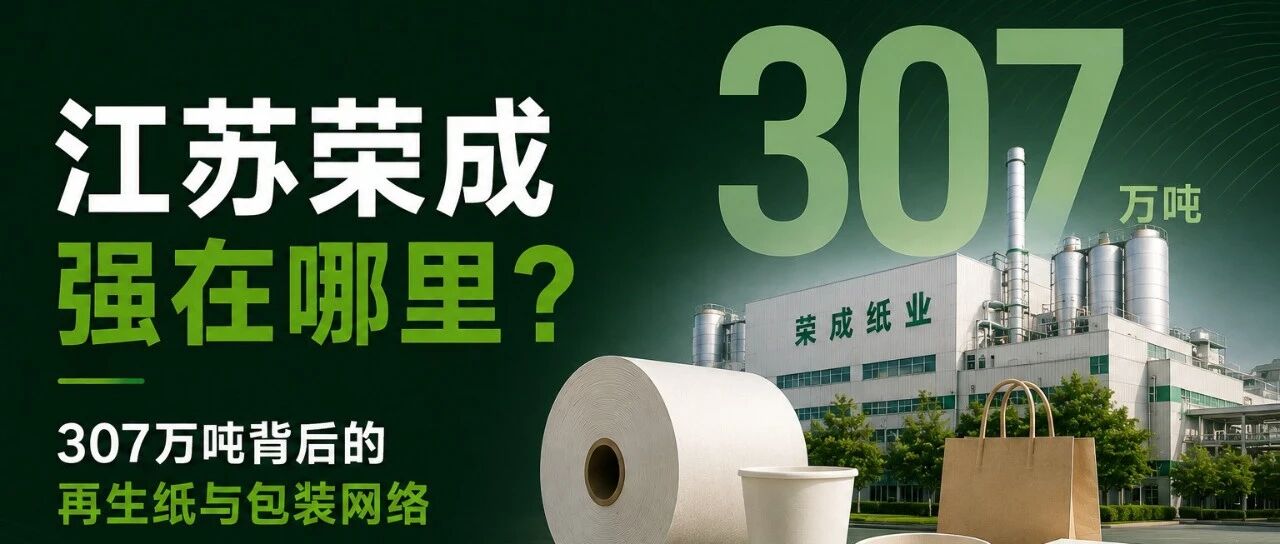
What Makes Longchen Paper & Packaging Strong? The Recovered-Paper and Packaging Network Behind 3.07 Million Tonnes
The 3.07-million-tonne figure is only a scale marker. The more important question is how Jiangsu Longchen Greentech integrates recovered fiber, three industrial-paper bases in mainland China, a corrugated-box network spanning East and Central China, and closed-loop energy and water systems into an operating manufacturing and delivery network.
Core Assessment
Jiangsu Longchen Greentech's industrial foundation is a regional network comprising recovered-fiber collection, three industrial-paper bases in mainland China, a corrugated-box network across East and Central China, and combined heat-and-power and water-recycling systems. In the first half of 2026, both the industrial-paper and corrugated-packaging segments of Longchen Paper & Packaging improved, providing operating evidence of the value created by integrating paper and box production.
Paper mills determine supply, while the corrugated-box network determines delivery; recovery, energy and water systems determine whether the network can endure.
01 · MANUFACTURING NETWORK
Behind 3.07 Million Tonnes Is a Mainland Manufacturing Network
According to the China Paper Association's 2025 Annual Report on China's Paper Industry, Jiangsu Longchen Greentech Co., Ltd. produced 3.07 million tonnes of paper and paperboard in 2025, down 0.97% year on year and ranking ninth among the key enterprises listed in the report. The association also notes that the ranking is based on the data it was able to collect.
This scale marker alone does not explain Jiangsu Longchen Greentech's organizational footprint. Longchen Paper & Packaging's consolidated financial statements for the second quarter of 2026 show that the group holds 100% of Jiangsu Longchen Greentech through Long Chen Paper (China) Holdings, Kunshan Rongzhong Investment and Suzhou Manguo Packaging. Jiangsu Longchen Greentech is, in turn, connected to industrial-paper bases in Wuxi, Pinghu and Hubei, as well as packaging operations in Kunshan, Suzhou, Shanghai, Hangzhou and Central China.
Longchen Paper & Packaging's website currently lists Wuxi Longchen, Pinghu Longchen and Hubei Longchen as its low-carbon papermaking bases in mainland China; its eco-packaging and corrugated-box network covers Kunshan, Suzhou, Shanghai, Hangzhou and several cities in Central China. The group's consolidated structure for the second quarter of 2026 also includes Jiaxing Longchen Intelligent Eco-Packaging Co., Ltd.
Three Reference Points
3.07 million tonnes: The 2025 paper and paperboard output reported by the association, used here only as a scale marker for this series.
Three industrial-paper bases: Wuxi, Pinghu and Hubei form the mainland base-paper supply platform.
Regional corrugated-box network: Located close to customers in East and Central China, the network converts base-paper capacity into corrugated board, boxes and delivery services.
Scope boundary: The association does not disclose whether the 3.07-million-tonne figure represents the output of Jiangsu Longchen Greentech as a single legal entity or an aggregate that includes related mainland paper mills. Longchen Paper & Packaging's 2024 Sustainability Report states that its mainland industrial-paper capacity was 3.3 million tonnes; the two figures cannot be used directly to calculate capacity utilization.
Sources: China Paper Association, 2025 Annual Report on China's Paper Industry; Longchen Paper & Packaging, consolidated financial statements for the second quarter of 2026.
02 · FROM FIBER TO DELIVERY
How the Network Runs from Recovered Fiber to Corrugated Boxes
Longchen Paper & Packaging describes itself as a vertically integrated manufacturer of low-carbon paper and eco-packaging that uses recovered paper as its primary raw material. Its main products include linerboard, corrugating medium, corrugated board and corrugated boxes. The 2024 Sustainability Report likewise places recovered-paper collection, low-carbon papermaking, eco-packaging and post-consumer product recovery within a single value chain.
The challenge in this chain is not simply whether recovered paper is available. Moisture, contaminants, stickies, ash content, fiber length and batch consistency affect pulp yield, paper-machine runnability, strength properties, and steam and chemical consumption per tonne—ultimately shaping the cost and quality of linerboard and corrugating medium.
Capability Path A · RECOVERY
Collection and sorting: Control moisture, contaminants, stickies and fiber damage to establish the basis for stable paper-machine operation and competitive cost per tonne.
Capability Path B · INDUSTRIAL PAPER
Industrial-paper production: Translate fiber quality into ring-crush strength, burst strength, basis-weight consistency and continuous-run efficiency.
Capability Path C · CORRUGATED PACKAGING
Corrugated board and boxes: Use flute profile, box design, printing, structural engineering and converting yield to translate base-paper performance into packaging performance.
Capability Path D · REGIONAL DELIVERY
Regional delivery: Use corrugated-box plants close to customers to shorten transport and response distances, enabling demand signals to flow back more quickly into board design and base-paper production.
The financial statements for the first half of 2026 report intercompany sales and receivables between paper mills in Wuxi, Pinghu and Hubei and packaging entities in Jiangsu, Xiasha, Suzhou, Wuhan and Hunan. These transactions confirm that actual supply relationships exist between the paper mills and corrugated-box plants, rather than merely links on an organizational chart.
Industrial paper secures base-paper supply; the corrugated-box network addresses customer proximity, lead times, structural design and service responsiveness. Because corrugated boxes have clear transport and service radii, regional plants can shorten delivery times and return customer feedback to manufacturing more quickly.
Sources: Longchen Paper & Packaging website, Company Profile; Longchen Paper & Packaging, 2024 Sustainability Report.
03 · OPERATING RESULTS
Both Paper and Packaging Returned to Profit in the First Half of 2026
In 2025, Longchen Paper & Packaging recorded consolidated revenue of NT$44.708 billion, down approximately 6.47% year on year; a consolidated gross margin of 9.85%; an operating loss of approximately NT$13 million; a net loss attributable to owners of the parent of approximately NT$517 million; and net cash inflows from operating activities of NT$1.141 billion. Even a fully integrated value chain remains exposed to the combined pressures of paper prices, demand, costs and production-line ramp-up.
Operating results improved more clearly in the first half of 2026: consolidated revenue reached NT$24.248 billion, up approximately 13.23% year on year; consolidated gross margin rose from 9.33% to 10.86%; operating profit was NT$232 million, compared with an operating loss of NT$121 million a year earlier; and net profit attributable to owners of the parent was NT$243 million, compared with a net loss of NT$570 million.
First-Half 2026 Operating Scorecard · Consolidated Group Basis
NT$24.248 billion Revenue
Up approximately 13.23% year on year; revenue from the China market was NT$19.705 billion, up approximately 20.06%.
10.86% Consolidated gross margin
Up approximately 1.53 percentage points from 9.33% in the prior-year period.
NT$1.338 billion Net cash flows from operating activities
Up approximately 99.68% from NT$670 million in the prior-year period.
Both core segments also returned to profit. External revenue from industrial paper was NT$18.109 billion, up approximately 15.48%, with segment profit of NT$314 million versus a loss of NT$305 million a year earlier. The corrugated-packaging segment—corrugated board and boxes—reported external revenue of NT$5.849 billion, up approximately 11.31%, and segment profit of NT$122 million versus a loss of NT$192 million.
The simultaneous improvement in revenue, gross margin, segment profit and operating cash flow says more about the system's operating quality than group net profit alone. Company-reported figures show cumulative consolidated revenue of NT$28.535 billion for January–July 2026, up 13.88%, with cumulative operating profit of NT$350 million and profit before tax of NT$478 million.
Financial scope: All amounts above are in New Taiwan dollars and are reported on the consolidated, segment or geographic basis of the Taiwan-listed parent, Longchen Paper & Packaging. They must not be presented as the standalone results of Jiangsu Longchen Greentech. The industrial-paper and corrugated-packaging segments include operations in both Taiwan and mainland China. The January–July figures are internally compiled, unaudited company data and remain subject to the financial statements reviewed or audited by the company's accountants.
Sources: Longchen Paper & Packaging, 2025 consolidated financial statements; Longchen Paper & Packaging, consolidated financial statements for the second quarter of 2026.
04 · CAPACITY REALISATION
The Hubei Base Will Determine Whether Scale Converts into Profit
Longchen Paper & Packaging's consolidated financial statements disclose that Hubei Longchen planned an annual paperboard capacity of 1.5 million tonnes together with a 100 MW combined heat-and-power project. The first-phase project, comprising 1.15 million tonnes of paperboard capacity and the CHP facility, has been completed. The second-phase 350,000-tonne production line has also been completed, but grid-connection procedures are still under way, with acceptance expected in 2026.
Each Project Stage Must Be Read Separately
Planned: 1.5 million tonnes of paperboard capacity plus 100 MW of combined heat and power.
Completed: The first-phase 1.15-million-tonne paperboard and CHP project; the second-phase 350,000-tonne production line.
Outstanding: Grid-connection procedures and acceptance for the second phase.
Operating delivery: Stable operating loads, energy consumption per unit, paper-machine efficiency, regional orders, internal offtake and cash flow.
The mainland investment schedule for the first half of 2026 shows that Hubei Longchen recorded a net loss of approximately NT$306 million. Over the same period, Pinghu Longchen earned approximately NT$29 million, while Wuxi Longchen and Jiangsu Longchen Greentech each recorded a small loss. The group's industrial-paper and corrugated-packaging segments returned to profit overall, but the individual bases remain at different operating stages.
The value of the Hubei base lies in linking recovered fiber in Central China with industrial-paper production, combined heat and power, and corrugated-box plants in Wuhan, Xiantao, Jingzhou and Hunan. The next indicators to watch are acceptance and operating load for the 350,000-tonne line, energy consumption per unit, paper-machine stability, internal offtake of base paper, regional orders and operating cash flow—not merely the planned capacity of 1.5 million tonnes.
Project boundary: Completion of a production line does not mean it has been connected to the grid, accepted, operated stably, run at full capacity or made profitable. Nor can Hubei Longchen's loss be attributed solely to the new line's ramp-up on the basis of public financial statements alone.
Source: Longchen Paper & Packaging, consolidated financial statements for the second quarter of 2026.
05 · NEXT OPERATING SYSTEM
Low Carbon, Intelligence and Organizational Restructuring Open the Next Phase
Longchen's circular capabilities extend beyond recovered-paper collection to combined heat and power, waste-heat recovery, water recycling, waste valorization and regional packaging. The company's 2024 Sustainability Report states that it operates three low-carbon paper mills and eight eco-packaging and corrugated-box plants in mainland China. It also says that, after mainland industrial-paper capacity reached 3.3 million tonnes, the operating focus shifted toward carbon reduction, expansion of corrugated-box operations, equipment upgrades and a higher internal-consumption ratio for industrial paper.
The company's 2026 public materials state that hardware and software upgrades at upstream industrial-paper mills and downstream corrugated-box plants over the past eight years have enabled production data to connect automatically, and that AI applications in manufacturing are planned for the next three years. Just-in-time operations, production scheduling, quality prediction, predictive maintenance, inventory management and transport dispatch are the most direct areas in which these digital capabilities can produce measurable results.
On 12 August 2026, Longchen Paper & Packaging's board approved a proposed transformation into an investment holding company. The plan would spin off the Taiwan industrial-paper and corrugated-packaging businesses into a wholly owned subsidiary and rename the parent Longchen Investment Holdings; the mainland business would continue to be managed by L&C and its subsidiaries. The proposal remains subject to approval at an extraordinary general meeting on 1 October 2026, with 4 January 2027 tentatively set as the effective date of the demerger.
The restructuring indicates that Longchen is seeking to separate regional accountability more clearly across Taiwan, mainland China, Japan and other overseas operations, assigning manufacturing, resource allocation and strategic partnerships to more clearly defined organizations. For Jiangsu Longchen Greentech, this may strengthen its role as the group's mainland industrial platform, but the actual impact will depend on shareholder approval and subsequent implementation.
Four Collaboration Interfaces Across the Value Chain
Recovered fiber and collection: Sorting purity, moisture, stickies, ash content, fiber damage and supply radius.
Chemicals, equipment and energy: Cost per tonne, paper-break frequency, machine speed, ring-crush strength, burst strength, and steam and water efficiency.
Corrugated board, boxes and brand owners: System-level optimization of basis weight, flute profile, compression strength, printing, stacking, logistics damage and lead times.
Digital operations: Connect models to real production metrics for scheduling, quality, maintenance, inventory and transport.
Evidence boundary: The company's disclosed low-carbon indicators, AI plans and organizational transformation represent corporate data, future plans and a proposal still awaiting approval, respectively. Each must be tested against energy consumption, yield, downtime, inventory turns, order quality, profit and cash flow.
Sources: Longchen Paper & Packaging website, Green Technology; Smart-Manufacturing Foundations and AI Applications; Longchen Paper & Packaging press release on its proposed transformation into an investment holding company.
CONCLUSION
Circular Manufacturing Must Ultimately Deliver Operating Results
The research value of Jiangsu Longchen Greentech lies in the circular-packaging system behind the 3.07-million-tonne scale marker: recovered fiber enters the Wuxi, Pinghu and Hubei paper mills; base paper then flows into corrugated-board and box plants across East and Central China; and energy, water and digital systems support both manufacturing and delivery.
In the first half of 2026, the industrial-paper and corrugated-packaging segments both returned to profit, revenue from the China market continued to grow, and operating cash flow improved materially. These results provide clearer operating evidence of Longchen's vertically integrated capabilities and illustrate the value that can emerge when recovered paper, a regional corrugated-box network and lean operations work together.
The next-phase agenda is clear: stabilize the new Hubei production line, increase internal offtake of industrial paper and the quality of corrugated-box orders, continue reducing energy and water costs, and translate AI deployment and organizational restructuring into measurable gains in efficiency, profit and cash flow.
When recovered fiber can be converted reliably into industrial paper, corrugated board and boxes—and delivered rapidly to regional customers—circular manufacturing becomes an operating capability capable of producing repeatable results.
NEXT COMPANY · NO.10
Next: Liansheng Paper
According to the China Paper Association's table of 2025 output by key enterprises, Liansheng Paper ranked tenth with paper and paperboard output of 2.824 million tonnes, up 0.57% year on year.
The ranking determines only the order of this series. The next article will develop an independent assessment after separate research, without presuming that Liansheng follows Jiangsu Longchen Greentech's model.
BIOTEN Packaging · Industry Insights · Research Notes
This article uses association statistics to establish the scale marker; Longchen Paper & Packaging's consolidated financial statements to verify entities and operating results; sustainability reports and the company website to analyze circular manufacturing; and official company releases to update organizational and smart-manufacturing developments. Information was verified through 18 August 2026.
The 3.07-million-tonne figure follows the reporting scope for Jiangsu Longchen Greentech Co., Ltd. in the China Paper Association's table; the association does not publicly disclose the scope of consolidation. Revenue, profit, cash flow, segment and mainland-subsidiary figures in New Taiwan dollars come from the consolidated financial statements of Taiwan-listed Longchen Paper & Packaging and its subsidiaries and must not be presented as the standalone results of Jiangsu Longchen Greentech.
Industrial-paper, corrugated-packaging and China-market revenue figures are reported on group segment or geographic bases; a single segment may include operations in both Taiwan and mainland China. Company sustainability and low-carbon data are corporate disclosures and are not substitutes for third-party product carbon footprints, evidence for a specific customer's packaging, or proof relating to an individual mill.
The July 2026 figures are internally compiled company data; the proposed investment-holding-company transformation remains subject to approval at an extraordinary general meeting; and grid connection and acceptance for the second-phase 350,000-tonne line in Hubei are still in progress. Project completion, acceptance, stable operation, full production and profitability are recorded as separate stages.
Data and Verification Sources
01 | China Paper Association, 2025 Annual Report on China's Paper Industry
02 | Longchen Paper & Packaging, 2025 Consolidated Financial Statements
03 | Longchen Paper & Packaging, Consolidated Financial Statements for the Second Quarter of 2026
04 | Longchen Paper & Packaging, 2024 Sustainability Report
05 | Longchen Paper & Packaging Website: Company Profile
06 | Longchen Paper & Packaging Website: Green Technology
07 | Longchen Paper & Packaging Press Release on Its Proposed Transformation into an Investment Holding Company
08 | Longchen Shareholders' Meeting: Smart-Manufacturing Foundations and AI Applications
09 | Longchen Paper & Packaging Website: Corrugated Board
10 | Longchen Paper & Packaging 2026 Low-Carbon Progress Release
11 | Longchen Paper & Packaging 2026 Monthly Self-Reported Consolidated Profit and Loss
12 | Longchen Paper & Packaging 2026 Monthly Self-Reported Revenue