





Golden Phoenix Paper’s technical challenge is not simply to make paper lighter, but to deliver strength, stability and reliable supply across different basis-weight ranges.
China’s Top 20 Paper Producers · No. 12 / CHINA PAPER INDUSTRY
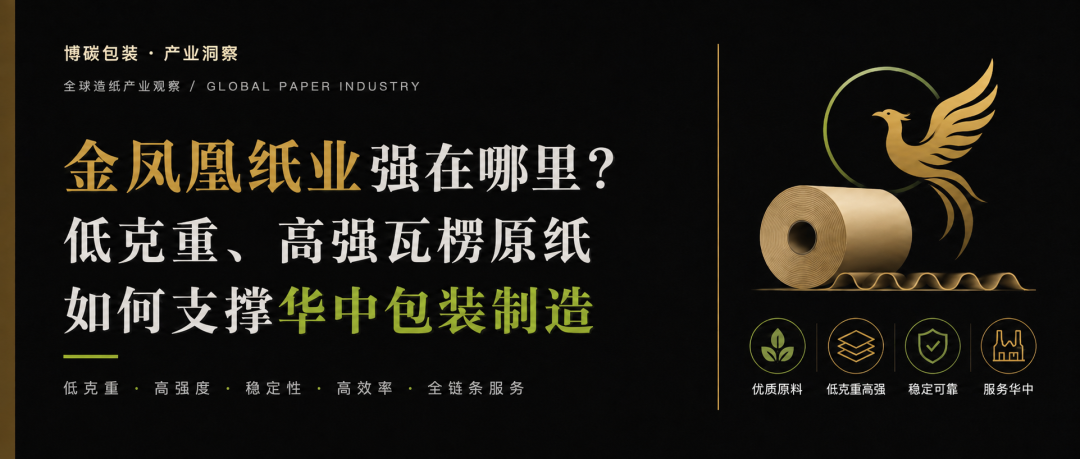
Ranked No. 12 in the China Paper Association’s production table of key enterprises. Golden Phoenix Paper stands out not for the breadth of its grades, but for integrating lightweighting, high strength and reliable delivery into one industrial packaging-paper manufacturing route based on domestically recovered paper.
MANUFACTURING PROPOSITION
Under the constraints of domestically recovered paper, Golden Phoenix Paper’s core technical challenge is to stabilise low basis weight, strength and reliable delivery at the same time. Output of 2.481 million tonnes and a No. 12 ranking define scale; finished-product yield, sheet strength and delivery consistency determine the quality of that scale.
The value of lightweight paper must be demonstrated jointly through strength per unit basis weight, finished-product yield and delivery consistency.
DATA SCOPE
In this series, “China’s Top 20 Paper Producers” is BIOTEN Packaging’s editorial label for its sequential study of the top 20 companies in the China Paper Association’s production table of key enterprises; it is not a separate consolidated-group ranking published by the Association. This article treats 2.481 million tonnes in the Association’s table as the annual output of Wuhan Golden Phoenix Paper Co., Ltd., and approximately 2.6 million tonnes reported by local media as the combined annual capacity of the two production bases; the two figures are not used to calculate a utilisation rate. The Wuhan Jinkou and Xiaogan Xiaonan sites correspond to separate legal entities. Claims concerning grades below 60 g/m², reclaimed-water recirculation above 95%, biogas and sludge cake are company or media disclosures. This article does not infer ownership, consolidated financial statements, unified production scheduling or cash flow beyond the available public evidence.
01 · SCALE & POSITION
First, Define the Business: Going Deep in Industrial Packaging Paper
The China Paper Association’s 2025 Annual Report on China’s Paper Industry shows that Wuhan Golden Phoenix Paper Co., Ltd. produced 2.2067 million tonnes of paper and paperboard in 2024 and 2.4810 million tonnes in 2025, up 12.43% year on year, ranking No. 12 in the production table of key paper enterprises. The Association also notes that the top 30 are ranked according to the data collected.
This position places Golden Phoenix Paper among China’s large paper producers, but scale alone does not explain its competitiveness. Public information on the Golden Phoenix Paper system identifies two production bases: Jinkou in Jiangxia District, Wuhan, and Xiaonan District, Xiaogan, each operated by a different legal entity. Production is concentrated on high-strength, low-basis-weight corrugating medium, with a publicly reported product range of 45–170 g/m². In 2026, Xiaonan District media described the two bases as having combined annual capacity of approximately 2.6 million tonnes. That figure comes from company and local-media reporting and is not the same measure as the Association’s production statistic.
Golden Phoenix Paper therefore should not be characterised as a broad, fully diversified paper group. A more precise lens is whether it can solve three linked problems in industrial packaging paper: maintaining a stable furnish supply from domestically recovered paper; preserving sheet strength at lower basis weights; and supplying finished paper consistently in line with corrugated-box plants’ production schedules.
Sources: China Paper Association, 2025 Annual Report on China’s Paper Industry; Paper Industry Observer, “Wuhan and Xiaogan Production Bases Can Produce 2.6 Million Tonnes of Corrugating Medium Annually.”
02 · LOW-GRAMMAGE / HIGH-STRENGTH
Lightweight and High Strength: Reduce Basis Weight, Not Performance
Lightweighting is not a matter of simply lowering the basis-weight number. At the paper stage, performance must be assessed through basis weight, density, cross-direction ring crush strength index, flat crush or post-corrugation compression performance, machine-direction breaking length, water absorptiveness and moisture at delivery. Once converted into corrugated board and boxes, flute-profile compatibility, CCT/ECT, BCT, bonding and forming must also be considered. These belong to different test levels and should not be collapsed into the shorthand of “ring crush, compression and burst strength.”
A 2024 Hubei Daily report cited staff at the Xiaogan plant as saying that domestic producers are relatively mature in making high-strength corrugating medium above 100 g/m², while Golden Phoenix Paper, through technical development, can produce grades below 60 g/m² without compromising specified strength performance. This is a technical claim made by company personnel in a media interview; it is not a substitute for customer laboratory results or third-party testing. It nevertheless defines the technical challenge clearly: the objective is not to make paper as thin as possible, but to stabilise strength per unit basis weight, paper-machine runnability and converting performance within a specified basis-weight window.
Accordingly, the statement that “performance and strength can be maintained below 60 g/m²” should be read only as the company’s public technical claim for particular products, process windows and customer specifications. It should not be generalised to every grade, basis weight or box design.
The real test is not whether a single roll of lightweight corrugating medium can be produced, but whether strength per unit basis weight, yield and converting performance can be maintained across batches, machines and order conditions. For the same packaging function, lightweighting may reduce fibre use and transportation load. The actual saving, however, must be calculated against the corrugated-board structure, flute profile, box dimensions, customer stacking requirements and real logistics conditions. “Lightweighting” cannot be presented as a guaranteed 10% cost reduction for every customer.
Suppliers and customers need to verify more than one strength figure. They should examine cross-machine basis-weight and moisture profiles, sheet-break frequency, broke rate, reel-end quality, board forming and batch consistency. The value of lightweighting is ultimately established by strength per unit basis weight, paper-machine runnability and downstream box performance together.
Sources: Hubei Daily Client, “Telling Industrial Stories Well: Xiaogan Ranks Among China’s Top 100 Advanced Manufacturing Cities for the Sixth Consecutive Year”; National Public Service Platform for Standards Information, GB/T 13023—2026, Corrugating Medium (Base) Paper.
03 · RECYCLED FIBRE LOOP
From Recovered Paper to Sheet: How the Mill Manages Furnish Variability
Public reports describe Golden Phoenix Paper as an industrial packaging-paper producer using domestically recovered paper. For a recycled-paper mill, the raw-material challenge is not simply whether recovered paper is available. It is how variations in fibre length, stickies, plastic film, ash content and moisture from different sources are managed through sorting, pulping, screening, cleaning and stock-preparation systems.
Publicly reported environmental operations at the Xiaogan base describe a loop more complete than the simple phrase “turning recovered paper into new paper”: approximately RMB 270 million was invested in a wastewater-treatment centre; Hubei Daily cited company personnel as reporting a reclaimed-water recirculation rate above 95% and annual freshwater savings of approximately 6.5 million tonnes. According to the report, separated waste plastic film is pelletised, pulp rejects and sludge are dewatered into cake and sent to the combined heat and power boiler, and biogas is recovered for use. The report also states that approximately 27 million cubic metres of biogas were recovered in the preceding year and sludge cake displaced about 3,000 tonnes of coal. These figures are operating data relayed by local media, not the findings of an annual environmental audit. Actual handling routes remain subject to environmental-impact approvals, pollutant-discharge permits and compliant solid-waste disposal documentation.
Contaminants and variability at the fibre input must be managed, absorbed and converted across stock preparation, wastewater treatment, solid-waste segregation and energy systems. The value of circular manufacturing does not come from attaching an environmental label to recovered paper. It comes from putting fibre losses, freshwater make-up, biogas utilisation, solid-waste destinations and emissions data for each tonne of paper on the same operating ledger. Long-term performance still requires verification through continuous operating records, pollutant-discharge permit data or third-party environmental data.
Sources: Hubei Daily, “Xiaogan Observation | Giving Recovered Paper a New Life”; Hubei Provincial Department of Economy and Information Technology, Xiaogan Paper, Hygiene Products and Plastics Packaging Industry Development Conference.
04 · TWO BASES / STANDARD
Two Bases: Beyond Transport Radius, Equipment Upgrades Matter
Wuhan Jinkou and Xiaogan Xiaonan are the two production bases identified in public reports. Their locations near the Central China packaging cluster offer the potential to shorten the transport radius for paper and leave room to allocate different machines, basis weights and order rhythms between sites. Public information is not sufficient to establish that the two sites already operate with unified production scheduling, furnish recipes or a single quality system; this remains an item for further observation.
Public information on a 2023 technical-upgrading project from Wuhan’s industry and information authorities shows that Golden Phoenix Paper planned upgrades to stock-preparation and press-section equipment as well as a white-water reuse system, with projected freshwater savings of 2,496 m³ per day and improvements in wet-end temperature, wire-section drainage and sheet-formation stability. Hubei Province’s second 2025 list of projects for private capital also includes the “Golden Phoenix Paper Integrated Quality, Efficiency, Energy-Saving and Carbon-Reduction Upgrade Project,” which proposes upgrading paper machines and supporting turbines, motors, Roots blowers and pulpers, and adding 50 units including permanent-magnet motors, magnetic-bearing motors and papermaking machines. The latter is a construction plan listed in a project schedule and must not be presented as an energy-saving result already achieved.
A further signal is the inclusion of Golden Phoenix Paper (Xiaogan) Co., Ltd. and Wuhan Golden Phoenix Paper Co., Ltd. among the drafting organisations for GB/T 13023—2026, Corrugating Medium (Base) Paper. This recommended national standard was issued on 25 May 2026 and will take effect on 1 December 2026. The two Golden Phoenix entities participated in drafting the product standard. This signifies participation in standards development; it does not mean that every company product has been certified, nor does it independently prove market quality. Specific inspection reports, customer acceptance records and batch data remain necessary.
Sources: Wuhan Municipal Bureau of Economy and Information Technology, Golden Phoenix Paper Quality and Efficiency Upgrade Project; Hubei Provincial Development and Reform Commission, Second List of Private Investment Projects for 2025; National Public Service Platform for Standards Information.
05 · SUPPLY CHAIN METRICS
What Matters Is Reliability After Lightweighting
For practitioners across the value chain, Golden Phoenix Paper raises a practical set of questions for on-site verification:
• Recovered-paper collectors and sorters should track fibre cleanliness, moisture, contaminant composition and batch variability;
• Stock-preparation, sizing and paper-machine suppliers should track the corrugating medium’s ring crush performance, short-span compression or flat crush, cross-machine basis-weight profile, moisture profile, sheet-break rate and finished-product yield;
• Water-treatment, anaerobic digestion, biogas and combined heat and power systems should track freshwater make-up per tonne of paper, energy recovery, solid-waste handling routes and emissions monitoring;
• Corrugated-box customers should track box compression performance, converting yield, batch variability, returns or complaints, and lead times.
The value of Golden Phoenix Paper as an industry case lies not only in machine scale, but in the fact that fibre, stock preparation, paper machines, water treatment, energy and delivery are integrated within a single industrial packaging-paper chain. The next stage of assessment should move beyond one capacity figure to the share of low-basis-weight grades, raw-material consumption per tonne, broke rate, machine uptime, freshwater make-up per tonne and customer batch performance. Only when these metrics are repeatedly achieved across batches and sites does lightweighting become a manufacturing capability that customers can rely on, rather than merely a product claim.
CONCLUSION
From Manufacturing Scale to Operating Quality
Golden Phoenix Paper’s path is clear. Instead of widening its grade portfolio, it is going deeper in industrial packaging paper: starting with domestically recovered paper, turning lightweight, high-strength corrugating medium into a stable product, and supporting operations through the Wuhan–Xiaogan two-base system, water recirculation, combined heat and power, and solid-waste segregation, while supplying corrugated-box customers across Central China and neighbouring markets.
Output of 2.481 million tonnes and a No. 12 ranking define scale. Lightweight grades, circular systems, participation in standards drafting, and quality-and-efficiency upgrade projects form capability signals worth tracking. The next step is to use customer testing, pollutant-discharge permit implementation, project acceptance and operating data to translate those signals into consistent basis weight, finished-product yield, lead times and repeat orders.
For the Central China packaging value chain, Golden Phoenix Paper’s value lies not only in supplying paper, but in offering a route to lightweighting without sacrificing reliability and to continuous manufacturing based on recovered fibre.
NEXT ARTICLE · No. 13 in the Association’s Production Table of Key Enterprises
Gold East Paper (Jiangsu) Co., Ltd.
2025 paper and paperboard output: 2.2711 million tonnes · Year on year: +2.50%
The next article will examine its fine-paper production base and APP China’s multi-site system. Source: China Paper Association, 2025 Annual Report on China’s Paper Industry.
BIOTEN Packaging · Industry Insight · Research Note
This article is an independent industry study by BIOTEN Packaging based on public sources. It cross-checks the China Paper Association’s annual production table, public documents from government departments, the national standards information platform, local Party newspapers and government media, and public materials from companies and suppliers. Association production data, media interviews, corporate disclosures, government project lists and analytical judgments are identified separately. Company publicity is not treated as audited financial information; project plans are not presented as completed operations; green-factory designations are not used as substitutes for current environmental performance; and product catalogues are not used as substitutes for evidence of customer quality, food-contact compliance or regulatory compliance. Information was verified as of 20 August 2026. This article does not constitute a collaboration endorsement, product certification, investment advice or a basis for transactions.
BIOTEN Observer: Data and Verification Sources
1. China Paper Association, 2025 Annual Report on China’s Paper Industry
2. National Public Service Platform for Standards Information: GB/T 13023—2026, Corrugating Medium (Base) Paper
3. Hubei Daily Client: “Telling Industrial Stories Well: Xiaogan Ranks Among China’s Top 100 Advanced Manufacturing Cities for the Sixth Consecutive Year”
4. Hubei Daily: “Xiaogan Observation | Giving Recovered Paper a New Life”
5. Wuhan Municipal Bureau of Economy and Information Technology: Golden Phoenix Paper Quality and Efficiency Upgrade Project
6. Hubei Provincial Department of Economy and Information Technology: Xiaogan Paper, Hygiene Products and Plastics Packaging Industry Development Conference
7. Hubei Provincial Development and Reform Commission: Second List of Private Investment Projects for 2025
8. Xiaogan Converged Media: Golden Phoenix Paper’s Two Bases Have Annual Corrugating-Medium Capacity of 2.6 Million Tonnes
9. General Office of the Ministry of Industry and Information Technology: Annex 1 to the 2023 Green Manufacturing List