














PAPER TALK · THE NUMBERS REVEAL THE ESSENCE: The need for every layer of packaging should be assessed at the merchant’s packing station.
Beijing’s New Takeaway Packaging Guide Takes Effect September 1 How Should Merchants Choose?
Starting with each menu item, what should merchants do? A five-step checklist: classify, select, verify safety, check end-of-life pathways, and standardize the SOP.
DB11/T 2510—2026, Guidelines for the Use of Green Packaging by Food-Delivery Merchants, was proposed, administered, and organized for implementation by the Beijing Municipal Commission of Development and Reform. Participating organizations included the China Export Commodities Packaging Research Institute, China Packaging Federation, China National Pulp and Paper Research Institute Co., Ltd., and YUTO Packaging. This article was researched and compiled jointly by BIOTEN Packaging and DBC’s Packaging Materials Division.
RESEARCH QUESTION
How Should a Takeaway Order Be Packaged?
The real issue is not whether the Guide will drive a particular material out of takeaway packaging. It is whether it can turn “green packaging” into an actionable decision framework at the merchant’s packing station: what packaging each menu item needs, how many layers it requires, whether it needs to be sealed, and which viable end-of-life pathway it should enter after use.
Analytical framework: Food classification → packaging selection → safe fulfilment → reduction and end-of-life checks → store SOPs → supply-chain evidence.
DB11/T 2510—2026 is not a materials blacklist. It is a set of decision rules for merchants that begins with safety and functionality, then minimizes material use, and finally connects the packaging to recycling, biodegradation, or reuse.
01 RECOMMENDATION / BOUNDARY
It Regulates Selection Logic, Not a Materials Blacklist
Local standards are recommended standards. The Standardization Law of the People’s Republic of China states that industry standards and local standards are recommended, while mandatory standards must be implemented and the adoption of recommended standards is encouraged. Accordingly, the Guide does not introduce a blanket ban on all takeaway packaging in Beijing from September 1, nor does it prohibit paper, plastic, aluminum foil, or biodegradable materials as a category.
Four Questions for the Packing Station
Is It Necessary? Does this film layer genuinely improve safety or delivery reliability?
Can It Be Reduced? Can it be made thinner or narrower, or can the lid or locking tabs provide the seal instead?
Can It Be Separated? Can the components be separated after use and enter a viable recycling, biodegradation, or reuse pathway?
Sources: Standardization Law; interpretation of the Beijing Guide
02 FOOD SCENARIO
Liquid Content and Temperature Begin to Determine Packaging Format
Official interpretations divide takeaway packaging into “simple packaging” and “sealed packaging.” A public interpretation reposted on the Beijing municipal government portal provides a more specific threshold: foods with no liquid, or fully enclosed foods whose liquid level does not exceed one-quarter of the container height, may use simple packaging; when the liquid level exceeds one-quarter, sealed packaging should be assessed. This one-quarter threshold is a classification criterion stated in the public interpretation and should not be treated as a standalone statutory provision.
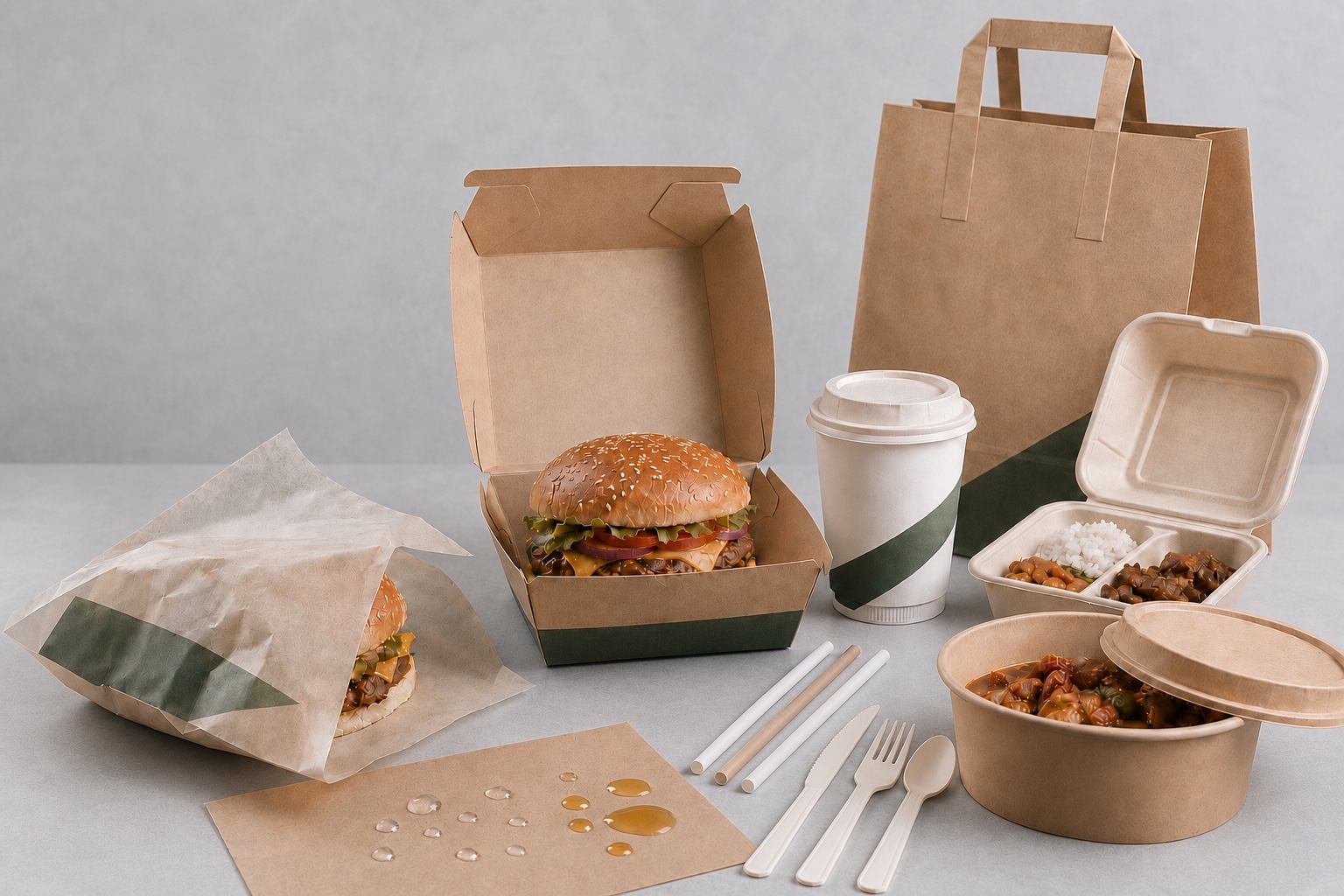
For ambient, chilled, and frozen products, plastic stretch film should not be used unless necessary. Where genuinely required for hot foods, a small amount of narrow sealing film may be used. For beverages, sealing paper that can be physically separated from the cup body is recommended.
Steamed buns and flatbreads may use bag packaging; hamburgers, sandwiches, and hot dogs should use fewer packaging layers; paper food boxes are recommended for pizza and cakes; stir-fried dishes and rice meals may use lidded containers without an additional sealing structure; barbecue foods may use aluminum foil with a sealing bag; and dumplings and sushi may use divided compartments to reduce crushing and flavor transfer.
Sources: Official interpretation by the Beijing Municipal Administration for Market Regulation; public interpretation on the Beijing government portal
03 FOUR PRINCIPLES
The Four Principles Form a Sequence, Not Four Parallel Slogans
01 | Safety First satisfy food hygiene, temperature resistance, leak prevention, and hygienic delivery requirements.
02 | Reduction Match packaging size to the food and reduce layers, film, empty space, and redundant outer bags.
03 | End-of-Life “Readily recyclable” and “biodegradable” are distinct pathways and must not be conflated through material labels.
04 | Reuse The public interpretation focuses primarily on the secondary use of outer packaging that does not come into direct contact with food.
Sources: Official interpretation by the Beijing Municipal Administration for Market Regulation
04 MERCHANT ACTIONS
What Should Merchants Do? A Five-Step Checklist
The Guide ultimately has to work at the packing station. Merchants do not need to begin by mastering every material term; they can start with each menu item and build their own packaging-selection rules in five steps.
01 / Classify the Menu
Record serving temperature, liquid level, fat content, delivery time, and leakage risk. Foods with no liquid, or with a liquid level no higher than one-quarter of the container, may first be assessed for simple packaging; above one-quarter, sealed packaging should be the focus of the assessment.
02 / Select the Packaging Format
For ambient, chilled, and frozen products, avoid plastic stretch film unless necessary. Where hot foods genuinely require it, use only a small amount of narrow sealing film. For beverages, prioritize sealing paper that can be separated from the cup body.
03 / Complete the Safety Check First
Verify food-contact and hygiene requirements, applicable temperatures, lid sealing, tamper evidence, leakage risks, and contamination risks during delivery. Material reduction must never compromise safe fulfilment.
04 / Check Reduction and End-of-Life Pathways
Match packaging size to the food, reduce layers and redundant outer bags, and prioritize mono-material or readily separable structures. When biodegradable materials are used, verify the applicable material standards, collection method, and treatment conditions at the same time.
05 / Standardize the Store SOP
BIOTEN recommends fixing the packaging model, assembly method, sealing-film conditions, and exception handling for each SKU; conducting real delivery tests before training staff; and continuously tracking packaging consumption, leakage complaints, rework rates, and procurement costs.
Three Don’ts: Do not mechanically replace all plastic with paper; do not remove seals where safety conditions are inadequate; and do not claim that “biodegradable” packaging has already delivered environmental benefits without applicable standards and viable end-of-life conditions.
Sources: Official interpretation by the Beijing Municipal Administration for Market Regulation; public interpretation on the Beijing government portal
05 CORE HIGHLIGHTS
Core Highlight: Turning Green Principles into Actions at the Packing Station
01 / RESPONSIBILITY
Move Responsibility Upstream Shift the focus from material names and test reports to the food, temperature, and delivery risks at the merchant’s packing station.
02 / SCENARIO
Scenario-Based Decisions Liquid content, temperature, fat content, and leakage risk jointly determine the packaging structure; materials no longer compete in isolation.
03 / ORDER
A Clear Sequence Safety is the baseline; reduction is the first action; recycling or biodegradation is the end-of-life pathway; and reuse extends value.
04 / PROCUREMENT
Actionable Procurement Stores can build a food-to-packaging matrix, while suppliers document safety, functionality, material usage, separability, and end-of-life conditions as evidence.
Sources: Official interpretation by the Beijing Municipal Administration for Market Regulation; public interpretation on the Beijing government portal
06 STANDARD CHAIN
Beijing Is Building a Three-Tier Standards Framework for Green Takeaway
01 / MANAGEMENT
GB/T 43285—2023 Addresses how green takeaway operations should be managed, covering enterprises, platforms, packaging, waste, and information disclosure.
02 / EVALUATION
DB11/T 2246—2024 Defines which takeaway packaging can be assessed as green.
03 / MERCHANT USE
DB11/T 2510—2026 Guides merchants on choosing and using packaging for different foods.
Sources: GB/T 43285—2023; DB11/T 2246—2024; announcement of DB11/T 2510—2026
07 ECOLOGICAL ENVIRONMENT CODE
The Ecological Environment Code Connects the Higher-Level Legal Framework
The Ecological Environment Code took effect on August 15, 2026. It does not convert every food-packaging action in the Beijing Guide into a uniform national rule, but it provides a clearer higher-level legal direction for green takeaway.
Article 953 / CIRCULAR ECONOMY
The circular economy is founded on reduction, reuse, and resource recovery, providing higher-level legal logic for “using one less layer, enabling reuse, and determining what happens after use.”
Articles 973 and 974 / PACKAGING
Encourage green and reduced packaging and prevent excessive packaging. The takeaway industry should reduce packaging, prioritize reusable and readily recyclable packaging, and actively promote recovery and recycling.
Article 1000 / GREEN SUPPLY CHAIN
Enterprises should implement green procurement, establish green supply chains, and drive coordinated green transformation upstream and downstream.
Article 1001 / FOOD SERVICE
Food-service enterprises should adopt material-saving and other technologies, equipment, and facilities that help protect the ecological environment, and reduce consumer goods that waste resources or cause pollution.
Sources: Ecological Environment Code
08 OPPORTUNITIES / CHALLENGES
Opportunities and Challenges for the Packaging Industry
Opportunity 1 | Shift from Selling Individual Packages to Delivering SKU Solutions. Food-service merchants need a food-to-packaging matrix: which structures correspond to temperature, liquid ratio, fat content, delivery distance, sealing risk, and eating method; which SKUs can eliminate one film layer; and which must retain a leak-prevention solution. Suppliers that can jointly deliver packaging, sealing, compartments, and store SOPs are closer to real procurement decisions.
Opportunity 2 | Turn the Standard into an Operating Interface for Brands and Platforms. Restaurant chains and delivery platforms can translate the Guide into procurement catalogs, store training, green-store assessments, and platform prompts. The recommended standard is not itself a blanket mandatory ban, but once cited in procurement contracts, platform rules, or brand-control standards, it may become a practical condition for supply-chain access.
Challenge 1 | Environmental Claims Cannot Override Functional Boundaries. High temperatures, high fat content, high liquid content, and long-distance delivery simultaneously increase the need for barrier performance, heat resistance, sealing, and transport reliability. Suppliers must demonstrate food-contact safety, resistance to oil, water, and heat, as well as sealing and leak prevention; labels such as “paper-based,” “plastic-free,” or “biodegradable” are not sufficient evidence on their own.
Challenge 2 | End-of-Life Pathways and Cost Must Both Be Viable. Readily recyclable packaging depends on identification, sorting, separation, and functioning recycling systems; biodegradability depends on material standards and compatible treatment conditions. The number of packaging layers, material use per meal, structural separability, viable paper-fiber recycling or biodegradation pathways, and merchant-acceptable cost must all be documented in the same evidence framework.
Opportunity 3 | Clear Openings Exist for Paper-Based Barriers, Separable Structures, and Sealing Materials. Paper-based packaging will gain clearer application opportunities, but “paper-based” does not automatically mean green. A sustainable product opportunity exists only when a specific SKU achieves the necessary functions with less material and demonstrates safety, performance, end-of-life pathways, and cost together.
The packaging industry therefore does not face a simple choice between “paper replacing plastic” and “plastic replacing paper.” The real question is whether materials, structures, store procedures, and end-of-life pathways can be integrated into a deliverable solution.
Sources: Official interpretations of DB11/T 2246—2024 and DB11/T 2510—2026
PAPER TALK · THE NUMBERS REVEAL THE ESSENCE
The core of this standard is not to order merchants to choose a particular material. It is to require every SKU to demonstrate why each packaging layer is necessary and where it will go after use.
BIOTEN Packaging · Industry Insights · Research Note
This article was independently researched and compiled by BIOTEN Packaging using materials from the Beijing Municipal Administration for Market Regulation, the Beijing municipal government portal, the National Public Service Platform for Standards Information, the Standardization Law of the People’s Republic of China, and other publicly available standards. Information was verified as of August 22, 2026. The article is provided solely for research and learning on green packaging and related value chains; it does not constitute compliance, procurement, engineering, investment, operating, or other decision-making advice. If you have concerns regarding the content, data, or rights, please leave a message requesting correction, clarification, or removal. We will review the request within 24 hours of receipt.
Data and Verification Sources for BIOTEN Observer
1. Announcement on Beijing Local Standards
2. Official interpretation by the Beijing Municipal Administration for Market Regulation
3. Standardization Law of the People’s Republic of China
4. GB/T 43285—2023; DB11/T 2246—2024
5. Public interpretation on the Beijing government portal; public text of DB11/T 2246
6. Full text of the Ecological Environment Code; implementation information from the National People’s Congress of China