







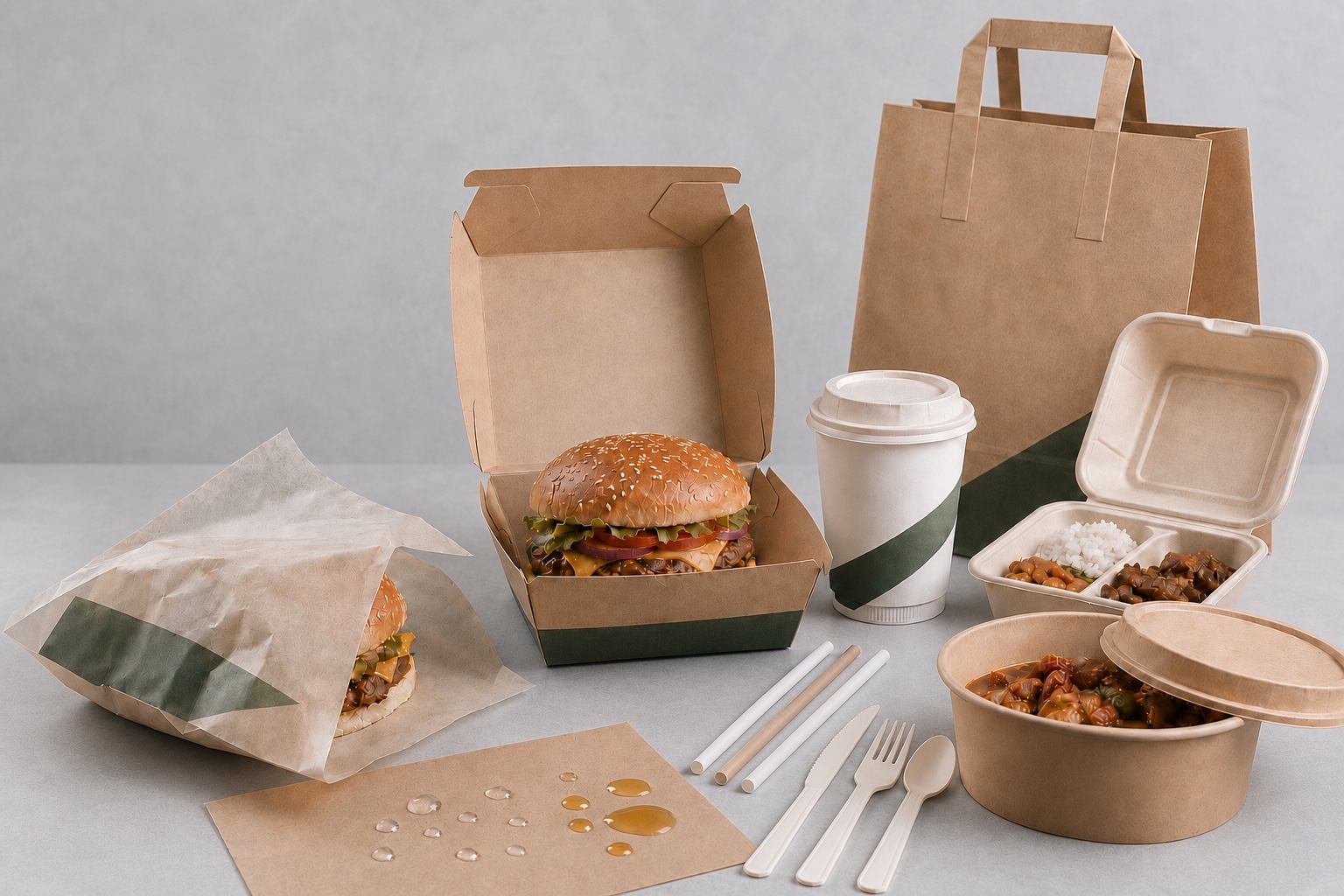



The real challenge in greening food-delivery packaging is not replacing one material with another. It is removing redundant layers while ensuring that every remaining layer still provides spill protection, load-bearing strength, thermal control and reliable delivery performance.
Rain is falling, an iced drink is sweating, and several hot meals have just left the kitchen. A staff member places the meal containers and cup tray in a paper bag, folds the top, and then adds a plastic bag or a heavy nonwoven bag just before dispatch. The extra layer is meant to prevent rain exposure, leakage and temperature interference—and to keep the bag closed until it reaches the customer. Every layer appears to have a reason, yet total material use may not fall at all.
Today, Beijing local standard DB11/T 2510—2026, Guidelines for the Use of Green Packaging by Food Delivery Merchants, takes effect. The official interpretation does not prescribe one universal replacement. Instead, packaging should be selected according to the food, temperature, liquid content and task: dimensions should fit, functions should not be duplicated, unnecessary layers should be removed, and sealing or insulation should be retained where required.
The Guide places safety, material reduction, recyclability or degradability, and reuse within one framework. Rather than selecting one generic bag for every merchant, it asks two questions of each packaging layer: Is it necessary? If it is removed, which component will take over its function?
Research sources: Beijing Local Standards Announcement; official interpretation by the Beijing Municipal Administration for Market Regulation

01 · FOUR ACTIONS
Four Actions Before Removing a Layer
Action 01 | Define the Use Case. Record the food type, temperature, liquid content, condensation, weight, delivery time and weather conditions. Soup noodles, fried foods, iced drinks and baked goods cannot share one assessment standard. The result should be an order-specific operating-condition sheet.
Action 02 | Eliminate Redundancy. Clarify the role of the container, closure and outer bag, layer by layer. Where insulation is unnecessary, do not use a heavy bag as redundant protection. The result should be a layer-by-layer material-reduction checklist.
Action 03 | Restore Required Functions. Assign spill protection to the cup lid, meal container or sealing film; combined load carrying to the paper bag; and localized oil, moisture and condensation management to materials and structures at the points where they are needed. The result should be a default functional architecture.
Action 04 | Validate the Complete Order. Use actual food, load and delivery time to test the bag base, side gussets, adhesive seams, handles, folds and closure. Record secondary bagging, leakage, complaints and redeliveries to create a traceable sample-validation record.
After these four steps, the result should be more than a claim that the packaging is “greener.” It should be an order-specific packaging specification that stores, procurement teams, quality teams and suppliers can all understand.
02 · THREE CONDITIONS
Three Gaps Created by Removing a Layer
Rainy-Day Delivery | External Protection. Rainwater can enter along folds, adhesive seams, the bag base and handle paths. The solution must address both the outer surface and the complete bag structure. The key question is where a loaded bag first softens and where it first fails.
Hot-and-Cold Orders | Localized Oil and Moisture. Condensation from cold drinks, steam from hot meals and small amounts of oil concentrate in specific locations. Containers and closures should retain free liquids; the paper bag should receive added functionality only at the points of actual contact.
Order Fulfilment | A Continuous Load Path. Cup trays and meal containers transfer weight through the bag base, side gussets, bag walls and paper handles. A fold-over top reduces exposure, while a paper seal helps indicate whether the bag has been opened.
Functions cannot disappear with the removed layer. If one outer layer is eliminated, the paper bag must take on more of the work.
03 · BIOTEN ROUTE
Protect the Outside, Protect the Inside, Reinforce the Fiber Core
BIOTEN Packaging integrates the three operating conditions into one scenario-based, end-to-end solution for food-delivery paper bags, built around one technical proposition: Protect the outside, protect the inside and reinforce the fiber core.
External Protection: Manage Rain Exposure. A PHA waterborne overprint varnish on the outer layer is a candidate surface-protection route. Its use should be determined by rainfall, exposure duration, paper grade and the complete bag structure.
Internal Protection: Manage Heat and Cold. Apply a PHA waterborne barrier coating only where condensation or light oil exposure occurs, avoiding undifferentiated full-bag coating.
Fiber-Core Reinforcement: Support Delivery Loads. A fiber-enhancing copolymer can support lightweighting while helping the packaging paper, paper handles, bag walls, side gussets and base form a continuous load path. A wide base accommodates meal containers and cup trays, while the fold-over top and paper seal manage the top of the package during delivery.
These three routes first address how the package should be designed and validated. The final configuration must be determined by the order conditions, the complete material structure and whole-bag testing.
04 · PRODUCT FAMILY
Paper Bags Should Be Specified by Task
Combined takeaway orders require a food-delivery carrier paper bag. Coffee shops, convenience stores, small-item retailers and prepackaged foods are better suited to an easy-grip paper bag. Hot, dry, slightly moist or oily single items—such as steamed buns, corn and grilled sausages—can use a ready-to-eat functional paper-bag route.
One store may need all three bag types: a carrier bag for the complete order, an easy-grip bag for rapid takeaway, and a ready-to-eat bag for short-duration holding. When the bag format follows the task, material use has a real opportunity to fall.
05 · PRESSURE TEST
With One Less Layer, How Can “Less Material, More Performance” Be Quantified?
If removing a layer causes leakage, condensation-related softening, secondary bagging or order redelivery, total resource consumption may rise instead. Paper, PHA, waterborne coatings and “one less layer” are all directions—not proof of performance.
The most direct review is to determine whether the number of packaging layers and material grammage have fallen, whether secondary bagging has decreased, whether leakage and redelivery have increased, and whether the used structure can enter a real local collection pathway.
06 · ONE-ORDER DIAGNOSIS
Start the Diagnosis with One Order
If you are redesigning a food-delivery bag, submit: Photographs of the current bag or packed order; dimensions of the meal containers and cup trays; typical weight per bag; delivery time; and rainy-day or insulation requirements.
BIOTEN provides: Recommendations on bag format and dimensions, an approach to paper-grade and localized-coating configuration, and a sample-validation checklist.
Project-specific matching: Resources for packaging paper, custom-coated or barrier paper, and finished food-delivery paper bags.
These five inputs are enough to start the first discussion and quickly identify whether the issue lies in dimensions, surface protection, localized barriers, or the load path through the handles and bag base. First make this order work; then discuss how to replicate the solution across more stores.
Valuable material reduction gives every layer a defined task, assigns every function to the right component and makes every order verifiable.
BIOTEN Packaging | Industry Insight | Research Note
This article was independently researched and prepared using public information from Beijing market-regulation authorities, government portals, development and reform authorities, and national standardization sources, together with information on the current product boundaries of BIOTEN Packaging. Information was verified through 1 September 2026. DB11/T 2510—2026 is a recommended Beijing local standard. Participation in drafting the standard does not constitute a recommendation or endorsement of BIOTEN products. Product configuration and performance remain subject to the final material structure and whole-bag validation. This article is provided solely for research and learning by the food-service packaging value chain and does not constitute legal, food-contact, certification, procurement, supply or investment advice. Requests for correction, clarification or removal will be reviewed within 24 hours of receipt.
BIOTEN Observer Data and Verification Sources
01 | Beijing Municipal Administration for Market Regulation | Beijing Local Standards Announcement No. 6 of 2026
02 | Beijing Municipal Administration for Market Regulation | Official Interpretation of the Guidelines for the Use of Green Packaging by Food Delivery Merchants
03 | Beijing Municipal People’s Government Portal | Food-Delivery Packaging Should Be Fit for Purpose and Not Excessive
04 | State Administration for Market Regulation | Standardization Law of the People’s Republic of China