















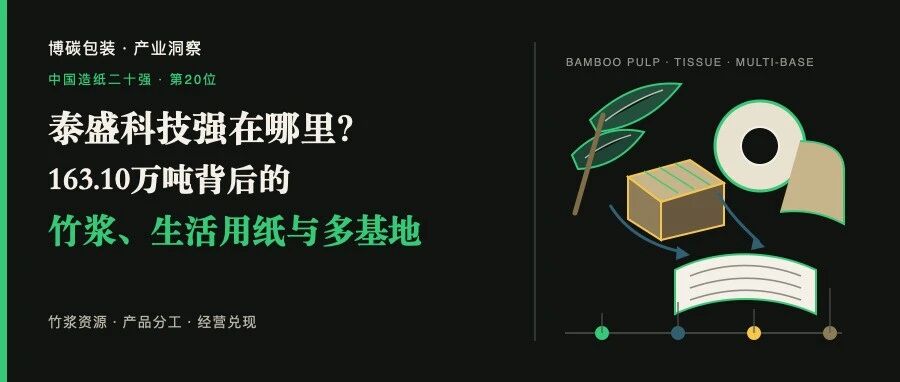
China’s Top 20 Paper Producers · No. 20
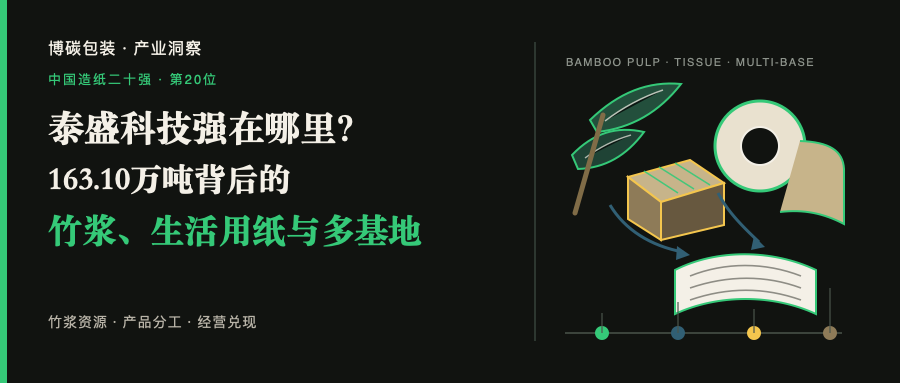
Why Is Taisheng Technology Strong? Behind 1.631 Million Tonnes: Bamboo Pulp, Tissue and a Multi-Site System
From bamboo resources and pulp-and-paper bases across multiple regions to tissue converting, this analysis examines the system capabilities behind Taisheng’s No. 20 ranking—and the operating questions that remain after scale.
Taisheng’s strength lies not only in 1.631 million tonnes of output, nor only in bamboo pulp. It lies in organizing regional bamboo resources, pulping, papermaking and converting into a multi-site system. Whether that scale can translate into operating quality still depends on products, channels and cash.
The association’s original table shows that its 2025 output rose 17.34% year on year. The same annex lists Shanying International separately at No. 4. Taisheng’s No. 20 position must therefore be interpreted by the specific Chinese entity, Taisheng Technology, without adding output from the broader affiliated ecosystem.
The association ranks companies only by the output data it has collected. Government projects, corporate and related-party disclosures, and site- and subsidiary-level figures all use distinct reporting bases. Because consolidated group revenue, profit and cash flow on a comparable basis were not available, this article does not rank operating quality.
1.631 million tonnes · 17.34% YoY · 20th place
Research source: China Paper Association 2025 Annual Report
01 · RANKING SCOPE
Identify the Ranked Entity First
According to association data, output at Taisheng Technology (Group) Co., Ltd. rose from 1.3900 million tonnes in 2024 to 1.6310 million tonnes, an increase of 17.34%. National paper and paperboard output grew 3.74% over the same period. By growth rate alone, Taisheng clearly outpaced total industry output.
However, the association states that its ranking is based on collected data and answers only how much paper the specified entity produced. Shanying International ranked No. 4 in the same table with 7.5453 million tonnes. Even though the two have shareholder and industrial ties, the two ranked entities cannot be combined for interpretation.
The No. 20 position is therefore a precise scale coordinate—not the total output of a corporate ecosystem, and not a composite score of revenue, profit, brand strength or technology.
Research sources: China Paper Association Annual Report; Shanying International 2025 Annual Report
02 · BAMBOO PULP
Bamboo Pulp: The Starting Point of the Resource Chain
In its table of major bamboo-pulp producers in 2025, the association places Taisheng in the first group, alongside Taisheng (Guizhou) Bamboo Resources, Sichuan Yongfeng Pulp & Paper, Luzhou Yongfeng Pulp & Paper, Sichuan Yongfeng Paper and Sichuan Tianzhu Bamboo Resources. The table does not state each company’s output, but it clearly identifies the resource base that distinguishes Taisheng from a conventional tissue producer.
Muchuan is the clearest example. Leshan sources show that Muchuan County has 820,000 mu of bamboo forest. Taisheng’s Muchuan site is built on bamboo-pulp sheets, printing and writing paper, and tissue, with an extension into specialty paper. The 820,000 mu is a county-level resource endowment, not company-owned bamboo forest. The real capability lies in sourcing, grading and pulping dispersed bamboo reliably, then matching the furnish to different paper grades.
A 2026 listed-company announcement also confirms that Taisheng Technology holds 89.53% of Guizhou Bamboo Resources and 75.99% of Sichuan Tianzhu. These equity relationships provide traceable organizational coordinates, but they do not prove that costs are identical across sites or that pulp can be substituted indiscriminately.
Research sources: Leshan Municipal Forestry and Parks Bureau materials on Muchuan; Shanying International related-party transaction announcement
03 · BASE ALLOCATION
Multiple Sites, Not Simple Replication
Taisheng’s sites perform different roles. Muchuan is built around bamboo pulp, printing and writing paper, and tissue, with an extension into specialty paper. The locality is advancing an integrated modern-bamboo-industry upgrade and capacity-expansion program, but the stated target of reaching 1 million tonnes after commissioning remains a project objective, not current effective capacity.
Chongqing’s Tongnan District is following a different route. In 2025, the Chongqing Municipal Development and Reform Commission approved in principle the energy-conservation report for a 100,000-tonne-per-year recovered-paper pulping project and an 80,000-tonne-per-year tissue project; the document gave a construction period from April 2025 to February 2026. EIA materials confirm that the project company is wholly owned by Taisheng Technology. As of this review, no official evidence was found that the project had reached design capacity.
Historical materials from the Suzhou Municipal People’s Government describe a tissue-converting industrial park and a cogeneration layout. Locating parent reels, converting operations and regional consumer markets close together can shorten transport and replenishment chains. But changeover efficiency, yield, inventory and order mix ultimately determine whether converting adds value.
Taken together, these examples suggest that Taisheng’s scale is organized around specialization: southwestern resource sites manage the bamboo-pulp and paper-grade mix; Chongqing adds recovered-fiber pulp and tissue; and Suzhou handles parent reels and converting. The number of sites is not a moat; consistent operating rules across sites are.
Research sources: Chongqing Municipal Development and Reform Commission project energy-conservation review; Suzhou Municipal People’s Government materials on the Suzhou–Ma’anshan Modern Industrial Park
04 · MARKET VALUE
Look at Operations Before Branding
Tissue and printing and writing paper follow different operating logics. Pulp sheets and parent reels depend more on fiber cost, machine efficiency and specification consistency. Converted tissue also requires embossing, rewinding, packaging, SKU management, channel turnover and brand investment. Taisheng already has tissue and converting entities, but that does not mean branded consumer products were its principal growth engine in 2025.
Comparable 2025 group-level data on brand revenue, channel structure, retail sales, inventory, receivables and operating cash flow were not available for the entity used in the association ranking. What is available is a public snapshot of several subsidiaries: all three were profitable, but their revenue scale and profit density differed.
Guizhou Bamboo Resources | 2025 revenue: RMB 2.119 billion; net profit: RMB 206 million.
Sichuan Tianzhu | 2025 revenue: RMB 830 million; net profit: RMB 28 million.
Taisheng Suzhou | 2025 revenue: RMB 2.256 billion; net profit: RMB 122 million.
Important boundary: These are audited subsidiary-level figures presented in shareholder-meeting materials. They represent the respective legal entities only and should neither be added together nor treated as group earnings.
05 · REALIZATION
What to Watch After No. 20
Capacity utilization | Machine load, first-pass yield, downtime and unit energy consumption across sites indicate whether nominal capacity can deliver stable output.
Product mix | Sales and revenue shares of bamboo pulp, recovered-fiber pulp, printing and writing paper, tissue, specialty paper and converted paper products.
Value capture | Unit gross profit, converting losses and comparable net selling prices for parent reels and converted products indicate whether downstream integration creates additional value.
Channel efficiency | Inventory turnover, receivable days, retail sell-through and repeat purchases of branded finished products indicate whether the paper is actually reaching consumers.
Cash and projects | Actual commissioning, ramp-up to design capacity and operating-cash-flow coverage of new projects indicate whether multi-site expansion can finance itself.
The output ranking ends at No. 20; the operating assessment is only beginning.
Taisheng’s most demonstrable foundation begins with bamboo resources and the organization of pulp and paper production across multiple sites. Tissue and converting provide a route for moving fiber value closer to the end market. A paper company’s real strength is not how many links it owns, but whether every link can deliver reliably—and ultimately retain customers, profit and cash.
BIOTEN Packaging · Industry Insights · Research Note
This article was independently compiled by BIOTEN Packaging from the China Paper Association, public corporate disclosures, Shanghai Stock Exchange announcements and local-government materials from Sichuan, Chongqing and Anhui. Information was verified through 2 September 2026. It is provided solely for research and learning on papermaking, pulp, tissue, packaging and industrial operations and does not constitute investment, procurement, product-compliance or engineering advice. Association output, government projects, corporate relationships and subsidiary financials are used on their respective reporting bases. No publicly disclosed investment, supply, customer or project relationship between BIOTEN Packaging and Taisheng Technology was identified. Requests for correction, clarification or removal regarding content, data or rights will be reviewed within 24 hours of receipt.
BIOTEN Observer Data and Verification Sources
01 | China Paper Association | China Paper Industry 2025 Annual Report
02 | Shanghai Stock Exchange | Public information on Taisheng Technology entities
03 | Leshan Municipal Forestry and Parks Bureau | Development of the Muchuan bamboo industry
04 | National Forestry and Grassland Administration | Sichuan Muchuan bamboo pulp and paper technical-upgrade project
05 | Chongqing Municipal Development and Reform Commission | Energy-conservation review for the recovered-paper pulping and tissue project
06 | Chongqing Municipal Ecology and Environment Bureau | EIA for the recovered-fiber pulp and tissue project
07 | Shanying International | Materials for the 2025 Annual General Meeting
08 | Suzhou Municipal People’s Government | Green papermaking industrial base in the Suzhou–Ma’anshan Modern Industrial Park