











Today, 6 September 2026, the global packaging industry marks its first shared day of celebration: World Packaging Day.
This is not a single event concentrated in one country. WPO has designed the inaugural World Packaging Day as a distributed participation platform, inviting packaging associations, companies, academic institutions and professionals to organise local seminars, open houses, innovation showcases and educational activities.
The Australasian Institute of Packaging has added 6 September to its events calendar; the Italian Packaging Institute, SYBA—the organisation coordinating activities in Czechia and Slovakia—and the Indian Institute of Packaging have also responded publicly. WPO states that registered activities will be included in the international calendar and amplified through coordinated communication under #WorldPackagingDay.
The date was not chosen at random. WPO was founded in Tokyo on 6 September 1968. Drawing on a member network spanning more than 60 countries, it has established four pillars for World Packaging Day: packaging for progress, packaging against food waste, packaging and economic growth, and packaging and sustainability.
Research sources: WPO | World Packaging Day; WPO | organisation profile; AIP | events calendar; SYBA | local event; Indian Institute of Packaging | event.
For China's paper-packaging value chain, this day cannot be treated merely as material for a promotional poster. In the 25 days preceding it, the EU Packaging and Packaging Waste Regulation (PPWR) began to apply on 12 August, and Beijing's Guidelines for the Use of Green Packaging by Food-delivery Merchants took effect on 1 September. These milestones differ in nature, yet together they shift the packaging question from “Which material should we choose?” to a much harder one: can the pack protect the product under real operating conditions, run reliably on production lines, enter a functioning circular system, and provide evidence that customers and regulators can understand?
According to the Annual Report on China's Paper Industry 2025 published by the China Paper Association, China's paper and paperboard output in 2025 reached 141.35 million tonnes, up 3.74%. The paper industry has a substantial manufacturing base, but tonnage does not automatically become orders, and a fibre-based format does not automatically become compliant.
Competition in packaging has shifted from “what material is used” to “whether functionality, production-line performance, circularity and evidence can be delivered together”.
25 days · Three milestones
12 August | The PPWR begins to apply across the EU, with its obligations phased in according to the regulatory timetable.
1 September | Beijing's local standard for green food-delivery packaging takes effect, bringing safety, source reduction, recyclability or degradability, and reuse into merchants' operating scenarios.
6 September | WPO launches the inaugural World Packaging Day, framing the value of packaging through progress, food-waste reduction, economic growth and sustainability.
Test one · Functional protection
Protect the product first; upgrade the material second
Neither the PPWR nor the Beijing guidelines treat substitution with a single material as the end goal. The Beijing guidelines are built around four principles—safety, source reduction, recyclability or degradability, and reuse—and distinguish between simple and sealed packaging for different food-delivery scenarios.
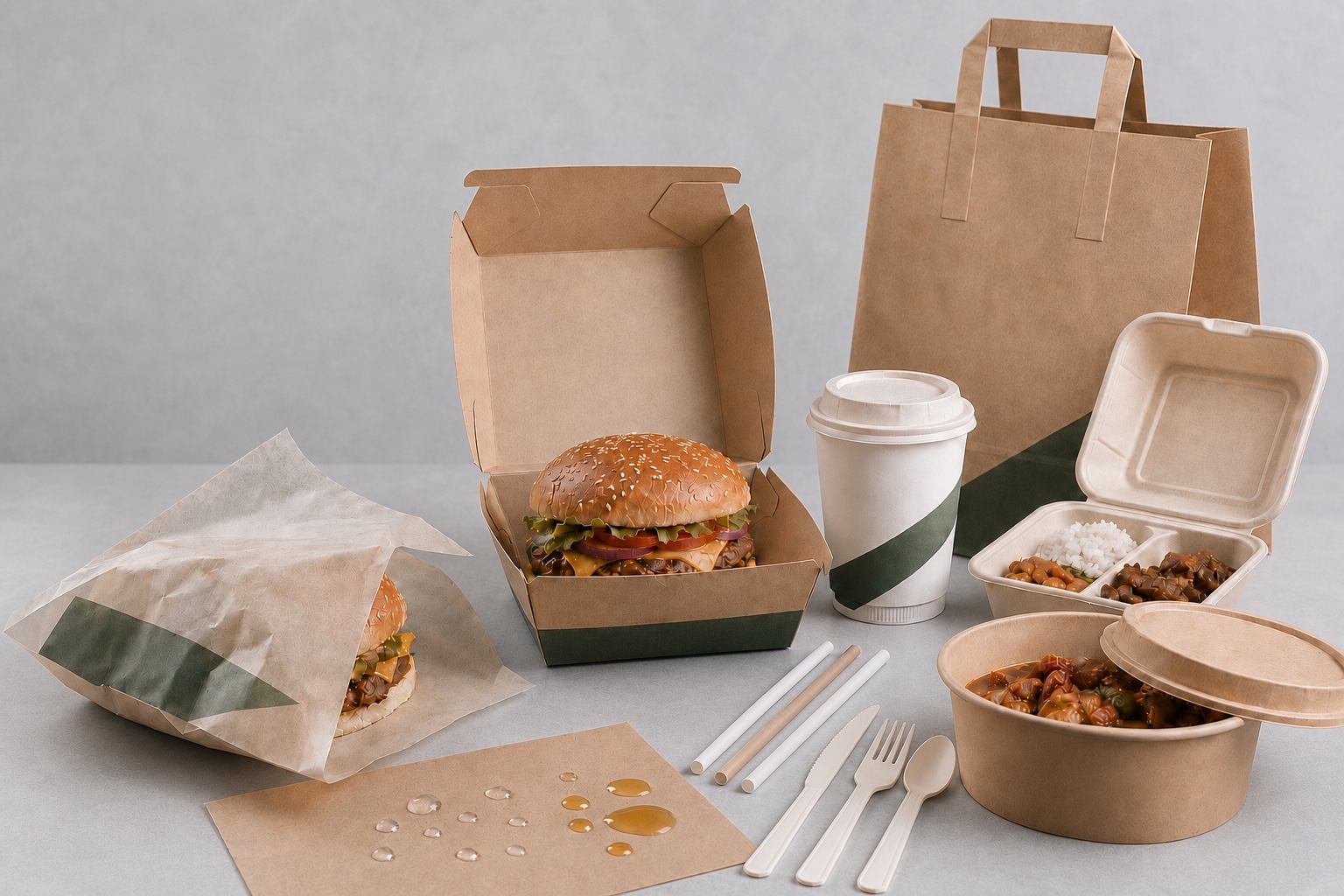
For paper cups, bowls, cartons, bags and foodservice board, the first test involves water, grease, heat, condensation, abrasion, stacking and transport. Paper strength, stiffness, fold endurance, printability, sealing and barrier layers must be designed together around the actual contents. Ultimately, protection must be measured through leakage, damage, contamination, post-transport appearance and product loss.
The foodservice paperboard case developed by Stora Enso and Swedish converter Aristo shows that grease resistance is only the starting point: the board must also retain structural strength and run reliably through folding, gluing and printing. For aqueous barriers, dispersion barriers and bio-based aqueous routes including PHA, development must likewise be grounded in defined foods, temperatures, contact times and forming conditions.
Research sources: Beijing Municipal Administration for Market Regulation | green food-delivery packaging guidelines; Stora Enso | foodservice paperboard case.
Metrics to watch | Leakage, damage, contamination, post-transport appearance and product loss.
Test two · Production-line delivery
A sample must become a consistently manufacturable product
Papermaking, surface treatment or coating, printing, die-cutting, bag making or forming, and final packing can amplify material differences at every stage. Variations in the paper surface affect printing and gluing; a mismatched coating operating window slows the line; and score cracking, unstable seals or excessive changeover times ultimately become waste, downtime and delivery pressure.
What converters need is not an attractive sample but a set of production records: converting yield, line speed, unit waste, changeover time, batch-to-batch consistency and on-time delivery. Paper producers should sell more than grammage and basis weight; they should provide a robust operating window that customers can reproduce.
Laboratory results show only that something may work; production-line data show that it can be delivered.
Metrics to watch | Converting yield, line speed, unit waste, changeover time, batch-to-batch consistency and on-time delivery.
Test three · Completing the loop
“Recyclable” needs a real next step
The PPWR's recyclability requirements are not a one-off label that takes effect all at once. They are phased: recyclability performance grades A, B and C apply from 2030; recycling-at-scale assessment is added in 2035; and market access tightens further in 2038. The detailed methodologies will also depend on subsequent delegated and implementing acts.
This requires paper-packaging companies to bring the question “Where does it go after use?” forward into the product-definition stage: can the structure be separated easily; are coatings, inks, adhesives and attachments compatible with the target paper stream; can consumers understand the sorting instructions; and can local collection and sorting systems actually receive it?
A four-country Bag-in-Box study
Smurfit Westrock studied whether consumers in Belgium, France, Germany and Sweden separate the cardboard box from the inner bag. The company reports that most respondents separated the components correctly, with the highest separation rate reaching 97%. It also notes that national collection systems, policies, education and sorting guidance influence the outcome.
This case is not representative of the Chinese market or of recycling rates for all paper packaging, but it identifies the essentials of circularity: materials, structures, behaviour and systems must all work together.
Research sources: EUR-Lex | Regulation (EU) 2025/40; Smurfit Westrock | separation and recycling study.
Metrics to watch | Separation completion rate, sorting error rate, collection coverage, sorting outcomes and the actual destination of recovered fibre.
Test four · Evidence and orders
Compliance evidence must stand up to procurement scrutiny
The value of packaging must ultimately translate into brand procurement, export orders and supplier assessments. Customers will ask: what product does this structure protect? On which line is it produced? Who conducted which tests? Where does it go after use? Can the supporting data be traced back to the base paper, coatings, inks, adhesives and finished pack?
The PPWR includes restrictions on PFAS in food-contact packaging, while the Beijing guidelines bring food-delivery merchants' choices back to specific requirements for safety, source reduction, recyclability and reuse. Exporters need regulations, test results and supplier documentation to form a coherent evidence chain; domestic suppliers are facing similar questions from brand-procurement standards and platform rules.
The fibre-based packaging concept developed by Stora Enso and Halton supports two-way logistics between a manufacturing site and construction sites. It is designed for multiple return trips, with the aims of reducing waste, improving resource efficiency, and lowering logistics and packaging costs. Its value lies not in the award itself but in its use within a real supply chain: trip count, handling efficiency, space utilisation, damage and repeat purchasing are the evidence that determines whether orders can continue.
Research sources: European Commission | PPWR implementation guidance; Stora Enso | fibre-based logistics packaging case.
Metrics to watch | Customer validation, document traceability, issue-closure time, first-order repeat purchasing, on-time delivery and cash collection.
Value-chain positioning
Who earns a seat depends on delivery capability
Paper producers | Work backwards from the finished pack and its operating conditions to define paper specifications, placing barrier performance, stiffness, printability and converting compatibility within the same development brief.
Functional-material suppliers | Upgrade a single barrier metric into combined validation of “material–structure–equipment–speed–yield”; use finished-product data to win orders for aqueous barriers, PHA and other technical routes.
Converters and equipment suppliers | Make prototyping produce records of forming cycle time, seal stability, waste rate and continuous-run performance.
Brand procurement | Move from purchasing “a green material” to purchasing a complete SKU defined by operating conditions, production-line data, compliance documents and an end-of-life pathway.
Recycling systems | Translate “recyclable” into consistent feedstock that can be sorted, repulped and traced.
Four questions after World Packaging Day
01 | Which design requirements, materials and evidence will regulations and customers write into the next round of procurement specifications?
02 | Can aqueous and bio-based barrier technologies narrow the cost and efficiency gap with incumbent structures under clearly defined operating conditions?
03 | Can collection, sorting and repulping systems handle the actual flows created by additional paper packaging?
04 | Can initial customer validation convert into repeat purchases, framework agreements and reliable cash collection?
World Packaging Day lasts only one day each year, but once the table is set, every subsequent material choice, line trial and customer delivery is put to the test.
Whether paper packaging earns a seat at the table does not depend on a “green” label. It depends on passing four tests at the same time: functional protection, production-line stability, a functioning circular pathway and evidence delivery.
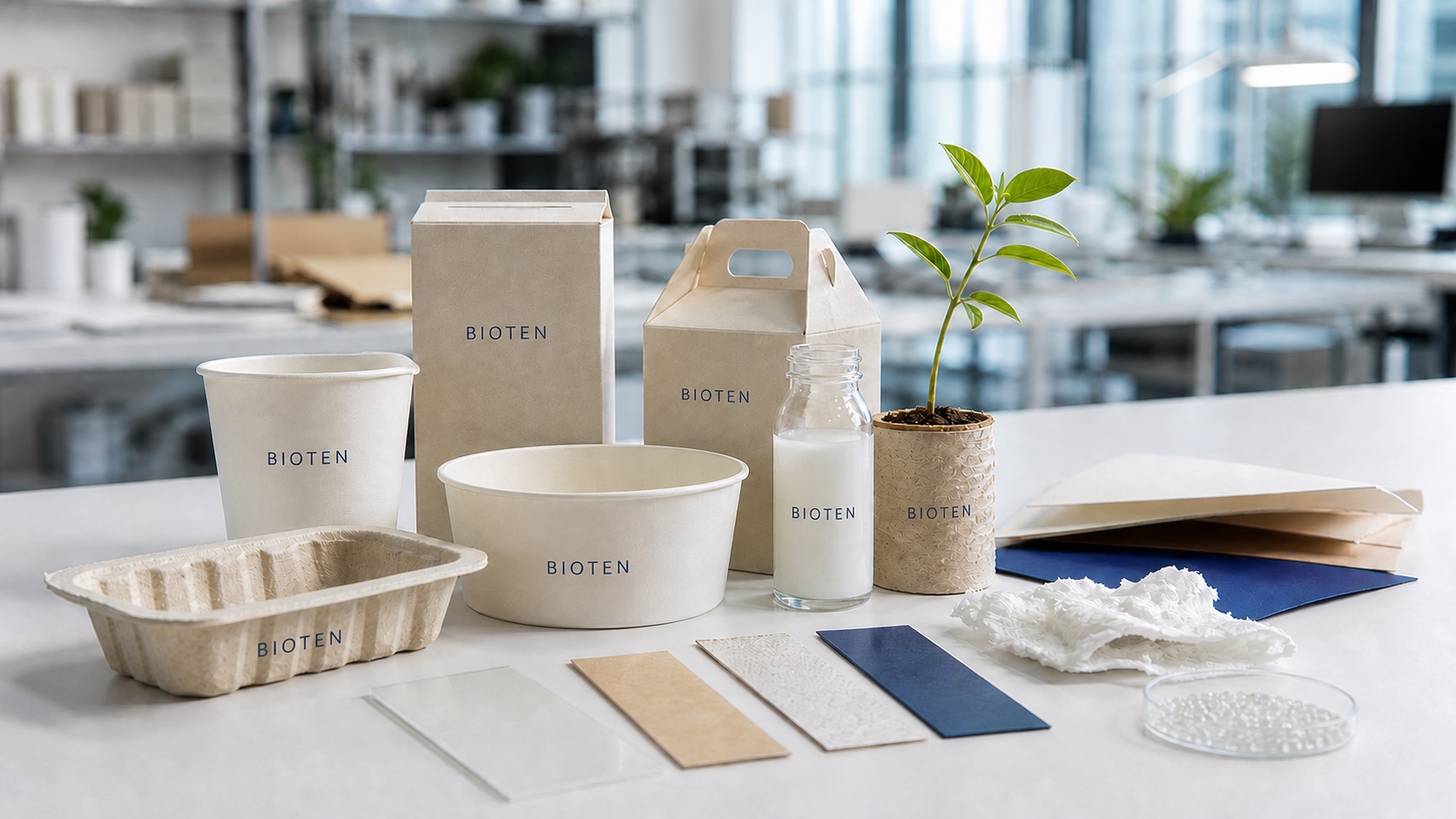
BIOTEN Packaging focuses precisely on collaborative validation across base paper, functional layers, converting, equipment and end-use conditions—so that paper becomes more than a material story and develops into a packaging capability that can be delivered, reordered and sustained.
Research note
This article was independently researched and compiled by BIOTEN Packaging from public documents issued by governments and industry organisations, publicly available company product information, and industry guidelines. Information was verified through 6 September 2026. It is provided for industry research and learning only and does not constitute a procurement or performance guarantee. To request a correction, clarification or removal, please contact this official account; we will review the request within 24 hours of receipt.
BIOTEN Observer data and verification sources
01 | European Commission | PPWR application
02 | EUR-Lex | Regulation (EU) 2025/40
03 | Beijing Municipal Administration for Market Regulation | Guidelines for the Use of Green Packaging by Food-delivery Merchants
04 | National Public Service Platform for Standards Information | DB11/T 2510-2026
05 | World Packaging Organisation | World Packaging Day
06 | World Packaging Organisation | Concept Note
07 | China Paper Association | Annual Report on China's Paper Industry 2025
08 | Stora Enso | foodservice paperboard case
09 | Stora Enso | fibre-based logistics packaging case
10 | Smurfit Westrock | Bag-in-Box separation study
11 | World Packaging Organisation | WPO in brief
12 | Australasian Institute of Packaging | World Packaging Day
13 | Istituto Italiano Imballaggio | World Packaging Day
14 | SYBA | Mezinárodní den obalů 2026
15 | Indian Institute of Packaging | World Packaging Day